Making the Decision: Renting vs. Buying Air Conditioners Based on Your Unique Situation
Making the Decision: Renting vs. Buying Air Conditioners Based on Your Unique Situation
 Ben Amina
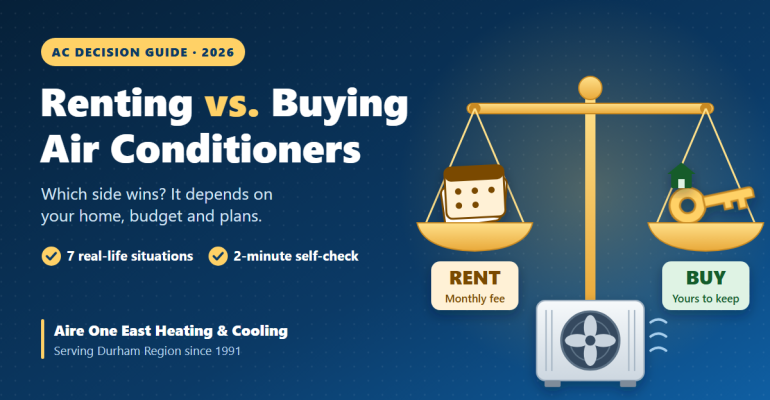
Renting vs. buying air conditioners is one of those decisions where the honest answer really is “it depends”, and that frustrates people. You want a straight answer. So instead of another generic pros-and-cons list, this guide starts from you: your home, your budget, how long you plan to stay and how much risk you are comfortable carrying. Find the situation that sounds like yours, run the two-minute self-check, and you will know which way you lean before you ever talk to a salesperson.
Short answer: if you plan to stay in your home for many years and can pay for the unit or finance it, buying an air conditioner usually costs less over its life because the payments end. Renting an air conditioner fits best when cash is tight right now, when you expect to move within a few years, or when you want repairs to be someone else’s job for a fixed monthly fee. If your furnace is also near the end of its life, price a heat pump before you decide on either.
Key takeaways
- There is no single “right” answer to renting vs. buying air conditioners. Four things decide it: how long you will stay, your cash and credit today, how much repair risk you can absorb, and the age of the rest of your system.
- Seven common situations below show which option usually wins, and why.
- A simple scorecard turns your answers into a clear lean: rent, buy, or finance.
- Ontario law protects you either way: AC contracts cannot be sold at your door unless you invited the company, and you get a 10-day cooling-off period on home contracts.
- Whatever you choose, compare the total paid over the same number of years, not just the monthly figure.
On this page: the four questions that decide it · renting vs. buying air conditioners by situation · the two-minute self-check · Ontario rules that protect you · what never changes · FAQs · references and resources.
Why “it depends” is the honest answer
On paper, renting vs. buying air conditioners always looks the same: an air conditioner rental spreads the cost into monthly payments that may never end, while buying an air conditioner costs more on day one and then stops. Over the full life of a central air conditioner, which is often 12 to 15 years in Ontario’s demanding climate, owning usually comes out ahead.
But real households do not live on paper. A young family that just closed on a house in Oshawa, a retired couple in Port Perry on a fixed pension, and a landlord with a tenant in Pickering can all look at the same two quotes and rightly make different choices. Here are the four questions that actually move the decision.
1. How long will you stay in this home?
This is the biggest one. The longer you stay, the more AC rental payments you make, and the more value you get from equipment you own. If you are likely to sell in a few years, the long-run savings of buying may never reach you, and an AC rental contract becomes something to hand over or buy out at closing.
2. What does your cash and credit look like today?
Buying outright needs savings. Financing needs credit approval and a monthly payment you are comfortable with. Renting an air conditioner usually asks for little or nothing upfront. None of these is wrong; they just fit different bank accounts. A choice that drains your emergency fund is a bad choice even if it is cheaper on paper.
3. How much repair risk can you carry?
When you own the unit, a failed compressor after the warranty ends is your bill. Most air conditioner rental plans bundle repairs and maintenance into the monthly fee. Some people sleep better paying a known amount every month; others prefer to keep that money and cover the occasional repair themselves, often with a maintenance and protection plan.
4. How old is the rest of your system?
Your air conditioner shares the furnace blower, ductwork and thermostat. If the furnace is 15 or more years old, replacing only the AC now can mean a second big decision in a year or two. That is the moment to look at a heat pump, which cools in summer and heats through much of the year, before buying an air conditioner on its own or signing another AC rental.
Renting vs. buying air conditioners by situation
Below are the seven situations where renting vs. buying air conditioners comes up most often for Durham Region homeowners. Each one shows which way the decision usually leans, why, and the one thing to watch out for. Read the one that sounds most like you, and skim the rest; many homes are a mix of two.
Situation 1: You just bought your first home and cash is tight after closing
Usually leans: finance, or rent short term
Closing costs, moving, furniture and a land transfer tax bill can empty savings fast. If the home came with an old or failing AC, buying an air conditioner in cash may not be realistic in year one.
Why: financing gets you the same equipment with monthly payments that end, so you build ownership while keeping cash on hand. If financing is not an option yet, renting an air conditioner covers you through the first summers without a large bill.
Watch out for: check whether the house already came with a rented unit. Many Ontario homes do. Ask for the contract and the buyout schedule before you add a second commitment on top of it.
Situation 2: You plan to sell within three to five years
Usually leans: rent, or repair what you have
If a move is on the horizon, the long-run savings of buying an air conditioner have little time to add up for you.
Why: a short stay favours lower upfront cost. That said, a working, newer AC that you own can be a small plus in a listing, while an AC rental contract becomes one more item for the buyer and the lawyers to deal with at closing.
Watch out for: before signing any air conditioner rental, ask exactly what happens when you sell: can the buyer take it over, and what would a buyout cost in year three, four or five? If your current unit is still sound, a tune-up or repair may carry you to the sale for far less than either option.
Situation 3: Your AC died in the middle of a heat wave
Usually leans: repair if possible, then decide calmly
This is when people sign things they later regret. The house is hot, the kids cannot sleep, and someone offers a solution today.
Why: speed matters, but so does the next 12 to 15 years. A reputable contractor can usually tell you whether the old unit can be repaired to get you through the hot spell, which buys you a week to compare renting an air conditioner, buying one and financing properly.
Watch out for: do not let urgency skip the paperwork. Ask for the total cost in writing, the term, any yearly increases and the cancellation terms. In Ontario you still have a 10-day cooling-off period on contracts signed at home (more on that below).
Situation 4: You are retired or living on a fixed income
Usually leans: rent, or buy with a protection plan
For many retirees, the main concern is not the lowest lifetime cost, it is avoiding a surprise bill.
Why: an AC rental’s fixed monthly fee, with repairs included, is easy to fit into a pension budget. On the other hand, if you have savings and plan to stay in the home for a long time, buying an air conditioner plus a yearly maintenance plan gives the same predictability with no payment that runs on forever.
Watch out for: look at any yearly increase in the AC rental rate. A small annual rise compounds over a long term. Also think about the home’s future: if it may be sold or passed to family, a rental contract will need to be assumed or bought out at that point.
Situation 5: You own a rental property
Usually leans: buy, unless cash flow is the priority
Landlords think about cooling differently: it is a business cost, tenants change, and repair calls come at inconvenient times.
Why: owning the equipment usually keeps long-run costs lower, and you control the brand, efficiency and service company. An air conditioner rental can make sense if you want to keep capital free for other projects and like having repairs bundled into one predictable expense.
Watch out for: make sure the lease is clear on who books maintenance, who changes filters and who calls for service, so small problems do not become big ones. Talk to your accountant about how each option is treated for your property.
Situation 6: Your furnace is 15 or more years old too
Usually leans: neither yet; price a heat pump first
Replacing a 15-year-old AC while the furnace beside it is the same age is like replacing one tire when all four are bald.
Why: a heat pump does the AC’s job in summer and heats your home through much of the year, often working with your existing furnace as backup on the coldest days. Ontario’s Home Renovation Savings Program offers rebates on eligible heat pumps, while it does not list standalone central air conditioners. See our heat pump cost guide for Durham Region and our heat pump vs furnace comparison.
Watch out for: rebate programs have their own rules, approved contractors and timing. Check eligibility before anything is installed, and ask whether a rented unit would qualify, since rules can differ for equipment you do not own.
Situation 7: You plan to stay 10 or more years and want the lowest lifetime cost
Usually leans: buy (cash or financing)
This is the classic case for ownership, and it is where most “forever home” owners land.
Why: once the unit is paid off, your cooling costs drop to electricity and a yearly tune-up. You choose the efficiency level, and an ENERGY STAR certified central air conditioner uses 8% less energy on average than a standard model, according to Natural Resources Canada. NRCan also notes that replacing a unit over 10 years old can save upwards of 30%.
Watch out for: buying an air conditioner only pays off if the unit is sized and installed correctly and then maintained every year. Ask for a proper cooling load calculation, not a copy of the old unit’s size. For current price ranges, see how much a new AC unit costs in Durham Region.
Your two-minute self-check
Answer each question honestly and note the column your answer points to. Then count. This is not a formula, but it quickly shows you where your situation lands when you weigh renting vs. buying air conditioners.
| Question | Points to RENT | Points to BUY or FINANCE |
|---|---|---|
| How long will you stay in this home? | Less than 5 years | 5 years or more |
| Could you cover the full cost without touching your emergency fund? | No | Yes, or you qualify for financing you are comfortable with |
| Would a large surprise repair bill cause real stress? | Yes | No, or you will add a protection plan |
| Do you want to choose the brand and efficiency level yourself? | Not important | Yes |
| Do you want the lowest total cost over 12 to 15 years? | Not my main goal | Yes |
| Do you like one fixed monthly cost with repairs included? | Yes | Not needed |
| Will you book a yearly tune-up on your own? | Probably not | Yes |
How to read your score: mostly “rent” answers mean an AC rental is a sensible fit, as long as you read the contract carefully. Mostly “buy” answers mean ownership will likely cost you less, and financing can bridge any cash gap. A close split usually points to financing, which gives you monthly payments like a rental but ends in ownership. And if your furnace is 15 or more years old, pause and price a heat pump before you decide (Situation 6).
What renting vs. buying air conditioners does not change
Some things matter no matter which option you pick. These are the questions we encourage every homeowner to ask, whether they rent or buy from us or from anyone else.
- Sizing: the unit should come from a cooling load calculation. NRCan warns that an oversized air conditioner is less effective and wastes energy. A rented unit that is the wrong size is just as uncomfortable as a purchased one.
- Installation quality: refrigerant charge, airflow and drainage are set on install day. Ask who does the installation and whether they are licensed.
- Yearly maintenance: NRCan recommends having the system serviced every year by a qualified HVAC contractor. With an AC rental, confirm in writing that the annual tune-up is included. When buying an air conditioner, put the tune-up on the calendar or add a plan.
- Apples-to-apples quotes: compare the same size and efficiency, and compare the total paid over the same number of years. Three numbers make that easy: the total of all rental payments over the term (including any yearly increases), the buyout cost at the years you might sell, and the purchase or financing total for the same unit. Our buying vs renting guide for Ajax includes a full contract checklist.
Ontario rules that protect you either way
Ontario has tightened the rules on home comfort contracts in recent years. Knowing them makes renting vs. buying air conditioners a calmer decision, whatever your situation.
No unsolicited door-to-door AC contracts
Under Ontario’s consumer protection rules, a business cannot sign you up for an air conditioner, furnace, water heater or similar product at your home unless you started the contact, for example by calling and asking them to visit. A technician on a repair or maintenance visit generally cannot sell you a new contract either, unless you already have a written contract with that business, they told you beforehand that they plan to make an offer, and you agreed to hear it. Source: Ontario.ca, door-to-door sales and home service contracts.
A 10-day cooling-off period
For these products, you have 10 days to cancel a contract signed at home for any reason, starting from the day you receive the written copy. If you asked for installation to happen within those 10 days, you may still owe some costs, such as rental payments for that time. So if your AC broke in a heat wave and you signed quickly, you still have time to reconsider.
No more liens on your home title for consumer HVAC
Since June 6, 2024, Ontario’s Homeowner Protection Act bans registering a notice of security interest (NOSI) on your property title for consumer goods such as air conditioning equipment, furnaces and water heaters. Existing consumer NOSIs were deemed expired. The province is clear, however, that the ban does not cancel an existing contract, so an air conditioner rental agreement still has to be paid out or transferred under its own terms. Source: Ontario.ca, notices of security interest.
If you have a problem with a contract, Consumer Protection Ontario explains your rights and how to file a complaint.
Renting vs. buying air conditioners: a quick recap by situation
| Your situation | Usually leans | The one thing to check |
|---|---|---|
| First home, cash tight after closing | Finance, or rent short term | Is there already a rented unit in the house? |
| Selling within 3 to 5 years | Rent, or repair what you have | The buyout cost in the year you plan to sell |
| AC died in a heat wave | Repair if possible, then decide calmly | Total cost and cancellation terms in writing |
| Retired or fixed income | Rent, or buy with a protection plan | Yearly rate increases over the full term |
| Rental property owner | Buy, unless cash flow comes first | Who handles maintenance in the lease |
| Furnace also 15+ years old | Price a heat pump first | Rebate eligibility before installation |
| Staying 10+ years | Buy (cash or financing) | Correct sizing and yearly maintenance |
Whichever way you lean, the best decision on renting vs. buying air conditioners is the one made with written quotes for the same unit, compared over the same number of years.
Talk it through with someone local. Aire One East Heating & Cooling is a family-owned Carrier Factory Authorized Dealer serving Durham Region since 1991. We offer both air conditioner rental and purchase options, flexible financing and protection plans, so we can show you all three side by side for your home.
Call 905-576-7600 or book a free in-home estimate. Monday to Saturday, 8 am to 8 pm, with 24/7 emergency service.
Frequently asked questions
Is renting or buying an air conditioner better for seniors?
It depends on savings and plans for the home. Renting an air conditioner gives a fixed monthly cost with repairs included, which suits a pension budget. Buying with a yearly maintenance plan is usually cheaper over time if you have savings and plan to stay for many years.
Should I rent or buy an AC if I might sell my house soon?
If you expect to sell within three to five years, renting or repairing your current unit often makes more sense than buying an air conditioner. Before signing, ask what happens at sale: whether the buyer can take over the contract and what the buyout would cost in the year you plan to sell.
Can I switch from renting to owning partway through a contract?
Many AC rental agreements include a buyout option, with a price that changes depending on how long you have paid. Ask for the full buyout schedule in writing before you sign, so you know your cost to own the unit at any point in the term.
Can a company sign me up for an AC rental at my door in Ontario?
Not unless you contacted them first. Ontario restricts door-to-door contracts for air conditioners, furnaces, water heaters and similar products. If you sign a contract at home, you have a 10-day cooling-off period to cancel for any reason after receiving the written copy.
Is renting an air conditioner a good idea for a rental property?
Landlords usually save more by owning, because they control the equipment and avoid a monthly payment that never ends. Renting can still make sense if you want to keep cash free and like having repairs bundled into one predictable monthly cost.
Should I replace my AC or get a heat pump if my furnace is old?
If your furnace is 15 or more years old, price a heat pump before replacing the AC alone. A heat pump cools in summer and heats through much of the year, and eligible models can qualify for Ontario rebates that standalone air conditioners do not.
References
- Government of Ontario. Door-to-door sales and home service contracts. Restricted products, who must start contact, and the 10-day cooling-off period.
- Government of Ontario. Notices of security interest (NOSIs). Homeowner Protection Act ban effective June 6, 2024.
- Natural Resources Canada. ENERGY STAR central air conditioners. Energy savings, sizing and maintenance guidance.
- Save on Energy (IESO). Home Renovation Savings Program. Eligible heat pump and home upgrade rebates in Ontario.
- Government of Ontario. Consumer Protection Ontario. Consumer rights and complaints.
Helpful resources
- AHRI Directory: look up ENERGY STAR certified central air conditioners. Natural Resources Canada suggests choosing “Split” or “Packaged” as the product type and “Yes” under “labeled ENERGY STAR”.
- New AC unit cost in Durham Region: 2026 price ranges by efficiency tier.
- How long does an air conditioner last in Ontario?
- Seasonal demand in Whitby: when to rent an AC and when to buy
- Heat pump cost in Durham Region
- Maintenance and protection plans