Furnace Leaking Water? Causes and What to Do
Furnace Leaking Water? Causes and What to Do

Aire One East Heating & Cooling, 1910 Dundas St E #117, Whitby
A furnace leaking water is almost always a high-efficiency furnace whose condensate system has stopped draining properly. These furnaces make water as part of normal operation, often several litres a day in a Durham winter, and a clogged drain line, a failed condensate pump, or a loose fitting sends it onto the floor instead of down the drain. This guide covers the eight most common causes, how to find where the water is coming from, what you can safely check yourself, and when to call a licensed technician. If the furnace has also stopped heating, see our furnace not working guide.
- High-efficiency furnaces produce water normally, so a leak usually means the condensate drain, trap, or pump is not doing its job.
- A clogged condensate line and a failed or unplugged condensate pump are the two most common causes.
- In a Durham cold snap, a condensate line running through a cold space can freeze and back up.
- Turn the furnace off at its power switch before you touch a wet area, because water and electrical parts do not mix.
- Water from inside the cabinet, rust, or a leak that keeps coming back needs a licensed technician.
Short answer: a furnace leaking water is usually caused by a clogged condensate drain line, a failed or full condensate pump, or a loose drain fitting on a high-efficiency furnace. Other causes are a frozen drain line, a leaking humidifier, or an air conditioner coil pan above the furnace.
Turn off the power at the furnace switch, soak up the water, and check the pump and drain line. If the leak continues, call a licensed technician. Aire One East offers 24/7 heating service across Durham Region. Call 905-576-7600.
Why is my furnace leaking water?
It depends on the type of furnace. A high-efficiency furnace, the kind with two white PVC pipes running outside, pulls so much heat from the exhaust that the water vapour in it condenses into liquid. That water, called condensate, flows through a small trap and a drain line to a floor drain, or into a condensate pump that pushes it to a drain. When any part of that path clogs, cracks, freezes, or fails, you end up with a furnace leaking water onto the floor. A standard-efficiency furnace does not make condensate, so if an older furnace is leaking, the water is more likely coming from a humidifier, the air conditioner coil above it, or venting problems. Finding which part is wet is the first step to the fix.
8 causes of a furnace leaking water
1. A clogged condensate drain line or trap
Over time, the condensate line and trap collect sludge, scale, and sometimes algae. When they clog, the water backs up and spills out of the trap or the furnace cabinet. This is the most common reason for a furnace leaking water. A technician can flush the trap and line and confirm the water flows freely. Many furnaces also have a safety switch that shuts the burners off when the drain backs up, so a clog can also cause a no-heat call.
2. A failed, full, or unplugged condensate pump
If your furnace is not next to a floor drain, a small condensate pump collects the water and pumps it away. When the pump motor fails, the float switch sticks, the outlet tube kinks, or the pump simply gets unplugged, the reservoir overflows onto the floor. Check that the pump is plugged in and that it hums and empties when the water rises. A pump that will not run leaves you with a furnace leaking water every cycle, so it needs to be replaced.

3. A loose or cracked drain fitting
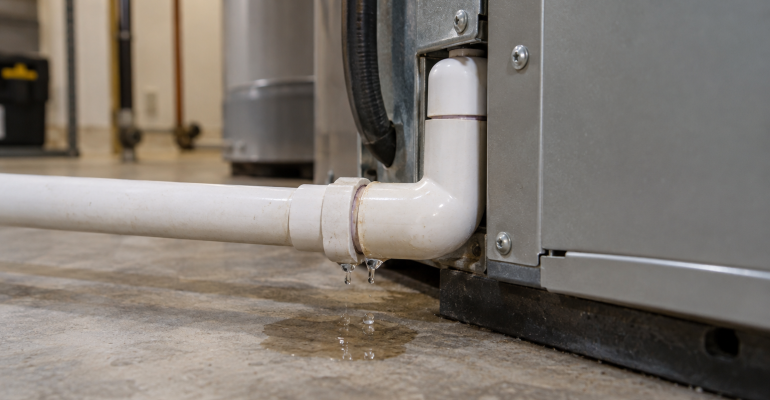
The PVC drain fittings and the rubber or vinyl tubing on a high-efficiency furnace can work loose, crack, or lose their seal over the years. The result is a furnace leaking water from a joint, often right where the drain leaves the cabinet. Look for drips at each fitting with a flashlight. A cracked fitting or failed seal should be replaced, not taped.

4. A frozen condensate line
Some condensate lines run through an unheated garage, crawl space, or outside wall. In a Durham cold snap, the water in that section can freeze, block the line, and back up into the furnace. You may see a furnace leaking water on the coldest days, or the furnace may shut down. A technician can reroute or insulate the line, or add heat tape where it is needed.
5. Condensation from the vent pipe
The PVC exhaust pipe on a high-efficiency furnace carries warm, moist air. If the pipe is not sloped back toward the furnace, or a joint is not sealed, condensation can run down the outside of the pipe or drip from a joint and look like a furnace leaking water. Snow or ice blocking the outside termination can make it worse. Venting must be installed to code, so call a technician to correct the slope or reseal the pipe.
6. A leaking whole-home humidifier
If a humidifier is mounted on your furnace ductwork, it has its own water supply and drain. A clogged drain, a worn water panel, or a stuck supply valve can send water down the side of the furnace, where it looks like a furnace leaking water. Check the humidifier first if the water is on the side where it is mounted. Our guide to whole-house humidifiers explains how they work.
7. The air conditioner coil or drain pan
The evaporator coil for your central air sits on top of the furnace and has its own drain pan. If that pan is rusted, cracked, or its drain is clogged, water can run down into the furnace, which many homeowners mistake for a furnace leaking water. This usually shows up in summer, but if the system was left in cooling mode or ice formed on the coil, the meltwater can appear in fall too. A technician can clear the drain or replace the pan.
8. A cracked secondary heat exchanger
High-efficiency furnaces have a secondary heat exchanger where the condensate forms. If it cracks or corrodes, water can leak inside the cabinet, and combustion gases may not be contained properly. Signs include rust inside the furnace, water under the burner area, or a CO alarm. This is not a DIY repair. Turn the furnace off and call a licensed gas technician right away.
Leak sources at a glance
| Where the water is | Likely cause | Who fixes it |
|---|---|---|
| Under the trap or furnace front | Clogged condensate line or trap | Technician flush |
| Around the condensate pump | Pump failed, unplugged, or full | You check power; replace if dead |
| Dripping from a PVC joint | Loose or cracked fitting | Technician |
| Only on the coldest days | Frozen condensate line | Technician, reroute or insulate |
| Down the outside of the vent pipe | Vent slope or joint problem | Technician, to code |
| On the humidifier side | Humidifier drain or valve | You check; technician repairs |
| Coming from above the furnace | AC coil drain pan | Technician |
| Inside the cabinet with rust | Cracked secondary heat exchanger | Licensed gas technician now |
Common causes of a furnace leaking water on Durham Region service calls, verified October 2026.
Quick checks you can do safely
These checks help you find the source of a furnace leaking water and sometimes fix it. None involve opening the burner area or touching gas parts.
- Switch the furnace off at its power switch, then soak up the water with towels so you can see where new drips appear.
- Follow the water to its source with a flashlight: the trap, a drain fitting, the condensate pump, the humidifier, or above the furnace.
- Make sure the condensate pump is plugged in. Pour a little water into it and confirm it turns on and empties.
- Check that the drain tube is not kinked or pulled out of the floor drain.
- Go outside and clear snow or ice from the two white PVC vent pipes.
If the water is coming from inside the cabinet, you see rust, or the leak starts again after a day, stop and call a technician.
When a furnace leaking water needs a pro
Call a licensed technician when a furnace leaking water keeps leaking after you have checked the pump and drain, when water comes from inside the cabinet, when you see rust or corrosion, when the furnace shuts off or will not heat, or when the condensate pump needs replacing. Venting and heat exchanger problems are gas appliance work, which in Ontario must be done by a TSSA-certified gas technician. Water left on the floor can damage flooring and drywall and lead to mould, so do not leave a leak for weeks. If your furnace is older and the problems keep adding up, our guide on whether to repair or replace your furnace can help. Our team handles emergency furnace repair in Ajax, furnace repair in Oshawa, and calls across Durham Region 24/7.
How to prevent furnace leaks
The easiest way to avoid a furnace leaking water is a yearly tune-up before winter. During a service visit, a technician flushes the condensate trap and line, tests the condensate pump, checks every drain fitting, inspects the vent slope, and looks for corrosion on the heat exchanger. At home, keep the condensate pump plugged into an outlet that is not switched off, keep the floor drain clear, and clear the outside vent pipes after each snowfall. Our furnace maintenance guide lists everything a tune-up should cover, and our maintenance and protection plans include it every year.
Key terms in this article
- Condensate: water that forms when a high-efficiency furnace pulls heat from its exhaust gases.
- Condensate trap: a small U-shaped fitting that holds water to block exhaust gases while letting condensate drain.
- Condensate pump: a small pump that collects condensate and pushes it to a drain when no floor drain is nearby.
- Secondary heat exchanger: the part of a high-efficiency furnace where condensate forms.
- Evaporator coil: the air conditioner coil that sits on top of the furnace and has its own drain pan.
Frequently asked questions
| Your furnace questions, answered |
|---|
| Why is my furnace leaking water? A furnace leaking water is usually a high-efficiency furnace with a clogged condensate drain line or trap, a failed or unplugged condensate pump, or a loose drain fitting. Other causes include a frozen drain line, a leaking humidifier, an air conditioner coil pan above the furnace, or, rarely, a cracked secondary heat exchanger. |
| Is a furnace leaking water dangerous? The water itself is usually not dangerous, but it can damage floors and drywall, cause mould, and reach electrical parts. Turn the furnace off at its power switch before touching wet areas. A leak inside the cabinet with rust can point to a cracked heat exchanger, which needs a licensed gas technician right away. |
| Is it normal for a furnace to produce water? Yes, for a high-efficiency furnace. It condenses water from its exhaust and drains it through a trap and line or a condensate pump, often several litres a day in winter. It is only a problem when that water ends up on the floor instead of in the drain. |
| Can I still run my furnace if it is leaking water? If the leak is small and coming from the drain or pump, you can usually run it briefly while you arrange service, keeping the area dry. If water is near electrical parts, comes from inside the cabinet, or the furnace keeps shutting off, turn it off and call a technician. |
| How much does it cost to fix a furnace leaking water? Many fixes are simple, such as plugging the pump back in or reconnecting a drain tube. Flushing a condensate line, replacing a fitting, or replacing a condensate pump is usually done in one service visit. Call 905-576-7600 for a quote for your Durham Region home. |
Do not take our word for it alone. Read our 364 verified reviews on Google, and see the Heating, Refrigeration and Air Conditioning Institute of Canada for what accredited contractors are expected to deliver.