Ductless Mini Split Heating in Ontario Winters: Does It Really Work?
Ductless Mini Split Heating in Ontario Winters: Does It Really Work?
 Ben Amina
Aire One East Heating & Cooling, 1910 Dundas St E #117, Whitby
A ductless mini split is a heat pump that heats and cools individual rooms without any ductwork: a compact outdoor unit connects through a small hole in the wall to one or more slim indoor units mounted high on the wall. Modern cold climate models keep heating efficiently well into a Durham winter, which makes a ductless mini split one of the best ways to warm a home without ducts, an addition, a finished basement, or a room the furnace never quite reaches. This guide explains how they work, how they handle Ontario cold, where they fit best, what they cost to run compared with electric baseboards, the 2026 rebates, and what installation involves. If you are comparing whole-home options, see our heat pump vs furnace guide.
- A ductless mini split heats and cools without ducts, using an outdoor unit and one or more indoor wall units.
- Cold climate models keep heating in deep cold, though output drops as it gets colder, so many homes keep a backup heat source.
- They are ideal for homes with electric baseboards, oil, or boilers, and for additions, basements, and rooms over garages.
- On most days a heat pump delivers far more heat per kilowatt-hour than electric baseboard heaters.
- Qualifying cold climate heat pumps can earn Home Renovation Savings rebates, with pre-approval required.
Short answer: yes, a cold climate ductless mini split works in Ontario winters. It heats efficiently through most of the season, provides air conditioning in summer, and needs no ductwork. In the coldest stretches its output drops, so it pairs well with existing baseboards, a furnace, or a boiler as backup.
It is a strong fit for homes without ducts and for problem rooms. Aire One East designs and installs ductless systems across Durham Region. Call 905-576-7600.
What is a ductless mini split?
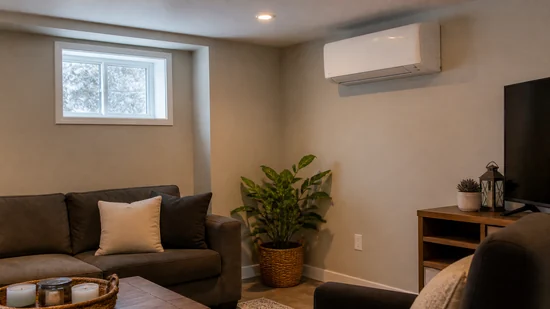
A ductless mini split is an air source heat pump split into two parts. The outdoor unit holds the compressor and outdoor coil. Each indoor unit, often called a head, holds a coil and a quiet fan and mounts high on a wall, near the ceiling, or in the ceiling itself. A small bundle of refrigerant lines, a drain line, and a power cable runs between them through a hole about 7 to 8 cm across. In winter the system pulls heat from the outdoor air and releases it indoors; in summer it reverses to cool. Each indoor head has its own setpoint and remote or app, so every room it serves can be controlled on its own.
Does a ductless mini split work in winter?
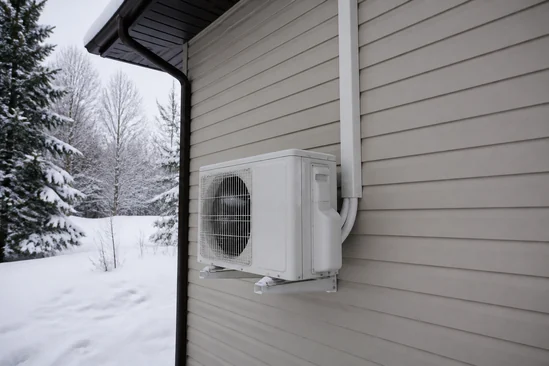
A cold climate ductless mini split is designed for Canadian winters. It keeps heating when the outdoor temperature drops well below freezing, and many models are rated to keep producing heat in the minus 20s Celsius. Check each model's rated range and its heating capacity at low temperatures, because output falls as it gets colder and the unit works harder. In a typical Durham winter, a properly sized system handles most days on its own. During deep cold snaps, many homeowners keep their existing baseboards, furnace, or boiler as backup. Like any air source heat pump, the outdoor unit also runs short defrost cycles in damp, freezing weather, which is normal. The outdoor unit should sit on a wall bracket or stand above typical snow levels.
Where a ductless mini split fits best
- Homes without ductwork: houses heated by electric baseboards, oil, or a hot water boiler can add efficient heat and air conditioning without installing ducts.
- Additions and renovations: new rooms that the existing ducts cannot reach.
- Finished basements: extra heat and dehumidifying cooling for lower levels.
- Rooms over garages and bonus rooms: spaces that are always colder or hotter than the rest of the house.
- Sunrooms, home offices, and garage conversions: rooms used at different times that benefit from their own control.
- Replacing window air conditioners: one indoor head is quieter, more efficient, and adds heat in winter.
Single zone vs multi zone
| Feature | Single zone | Multi zone |
|---|---|---|
| Setup | One outdoor unit, one indoor head | One outdoor unit, two or more indoor heads |
| Best for | One room, addition, or basement | Several rooms or a whole floor |
| Control | One setpoint | Separate setpoint in each room |
| Efficiency | Usually highest | Very good, depends on sizing of each head |
| Upfront cost | Lower | Higher, more heads and line sets |
For a whole house with many rooms, a ducted heat pump can sometimes be simpler. Our heat pump installation team can compare both for your home.
Running costs and rebates
Electric baseboard heaters turn one unit of electricity into one unit of heat. A heat pump moves heat instead of making it, so on milder winter days a ductless mini split can deliver two to three times more heat for the same electricity, and it still beats baseboards on most cold days. That is why switching from baseboards to a ductless mini split often brings the biggest savings. Compared with natural gas, the savings depend on your gas and electricity prices and on how the system is used.
Ontario's Home Renovation Savings Program offers rebates for qualifying cold climate air source heat pumps, which can include ductless models on the program's qualified products list. As of November 2026, the program lists up to $7,500 CAD for homes that heat with electricity, oil, propane, or wood, and up to $2,000 CAD for homes that heat with natural gas. The work goes through a participating contractor, and pre-approval is mandatory before installation. Rebates change, so we confirm the current amounts and the model's eligibility before any work starts. See our heat pump installation guide for more on the process.
Pros and cons
Pros. It needs no ductwork, heats and cools from one system, lets you set each room separately, runs quietly, and is very efficient, especially compared with electric baseboards. Installation is usually quick and tidy.
Cons. The indoor heads are visible on the wall, each room needs its own head, which adds cost for many rooms, the filters need regular cleaning, and output drops in extreme cold, so a backup heat source is wise. The outdoor unit needs space and protection from snow and roof runoff.
What installation involves
- A technician assesses each room, calculates its heat loss, and sizes each indoor head.
- Indoor head locations are chosen for good airflow, usually high on an outside wall.
- The outdoor unit is set on a wall bracket or stand above typical snow levels, away from roof drip lines.
- A small hole is drilled for the line set, which is run in a neat cover outside.
- The refrigerant lines are connected, pressure tested, and evacuated, and the condensate drain and electrical are completed.
- The system is started, tested in heating and cooling, and set up with you.
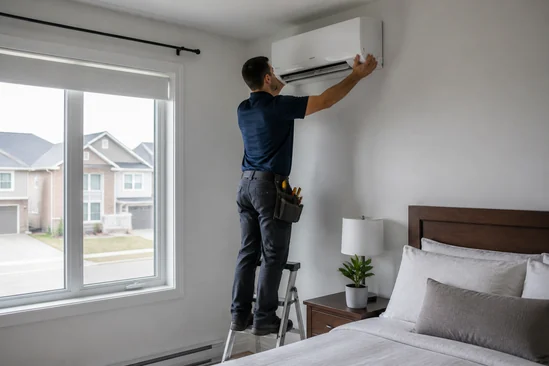
A single zone system is often installed in about a day, and multi zone systems take longer. Refrigerant work must be done by a licensed refrigeration technician, and electrical connections by a qualified installer. We install ductless systems across Durham Region, including Pickering, and you can see an example of the ductless heat pump models we carry.
Maintenance
Ductless systems are easy to look after. Rinse or vacuum the washable indoor filters every few weeks during heavy use, keep furniture and curtains away from the indoor heads, and keep the outdoor unit clear of snow, ice, and leaves. Book a professional service once a year so a technician can clean the coils and drain, check the refrigerant and electrical connections, and test heating and cooling. Our heat pump maintenance guide lists what a visit covers, our maintenance and protection plans include it, and if something goes wrong, our heat pump not working guide covers the first checks.
Key terms in this article
- Ductless mini split: a heat pump with an outdoor unit and one or more wall-mounted indoor units, with no ductwork.
- Indoor head: the wall or ceiling unit that delivers heated or cooled air to a room.
- Line set: the insulated refrigerant lines, drain, and cable that connect the indoor and outdoor units.
- Zone: a room or area controlled by its own indoor head and setpoint.
- Cold climate heat pump: a heat pump designed to keep heating efficiently at low outdoor temperatures.
Frequently asked questions
| Your ductless questions, answered |
|---|
| Does a ductless mini split work in Ontario winters? Yes. Cold climate ductless mini splits keep heating well below freezing, and many are rated to produce heat in the minus 20s Celsius. Output drops as it gets colder, so many homes keep existing baseboards, a furnace, or a boiler as backup for the coldest days. |
| Can a ductless mini split heat a whole house? It can, with a multi zone system that has an indoor head in each main area, especially in smaller or open-concept homes. For larger homes with many rooms, a ducted heat pump or a ductless system paired with existing heat is often a better fit. |
| Is a ductless mini split cheaper to run than electric baseboard heat? Usually, yes. Baseboards turn one unit of electricity into one unit of heat, while a heat pump moves heat and can deliver two to three times as much heat for the same electricity on milder days, and still beats baseboards on most cold days. |
| Are there rebates for ductless mini splits in Ontario? Qualifying cold climate air source heat pumps, which can include ductless models on the program's list, can earn Home Renovation Savings rebates. As of November 2026, the program lists up to $7,500 CAD for homes heated by electricity, oil, propane, or wood, and up to $2,000 CAD for natural gas heated homes. Pre-approval is mandatory. |
| How long does it take to install a ductless mini split? A single zone ductless mini split is often installed in about a day. Multi zone systems with several indoor heads take longer, depending on line set routing and electrical work. |
Do not take our word for it alone. Read our 364 verified reviews on Google, and see the Heating, Refrigeration and Air Conditioning Institute of Canada for what accredited contractors are expected to deliver.
References and further reading